
To help you feel comfortable and confident on the day of your FUE transplant, we’ve pulled together this step-by-step guide on what to expect.
An FUE hair transplant is a same-day outpatient procedure under local anaesthetic, typically taking 6–8 hours. This means that you won’t have to worry about bringing too much on the day. We’ll provide you with everything you need to feel comfortable, and you’ll be ready to go home once the full procedure is complete.
Let’s take a look at what your day will look like once you visit us here at our Manchester hair transplant clinic.
In the weeks before: how to prepare for a hair transplant
Before you step foot in the clinic, there are a few things you’ll want to do to ensure a seamless experience.
Your consultation and graft assessment
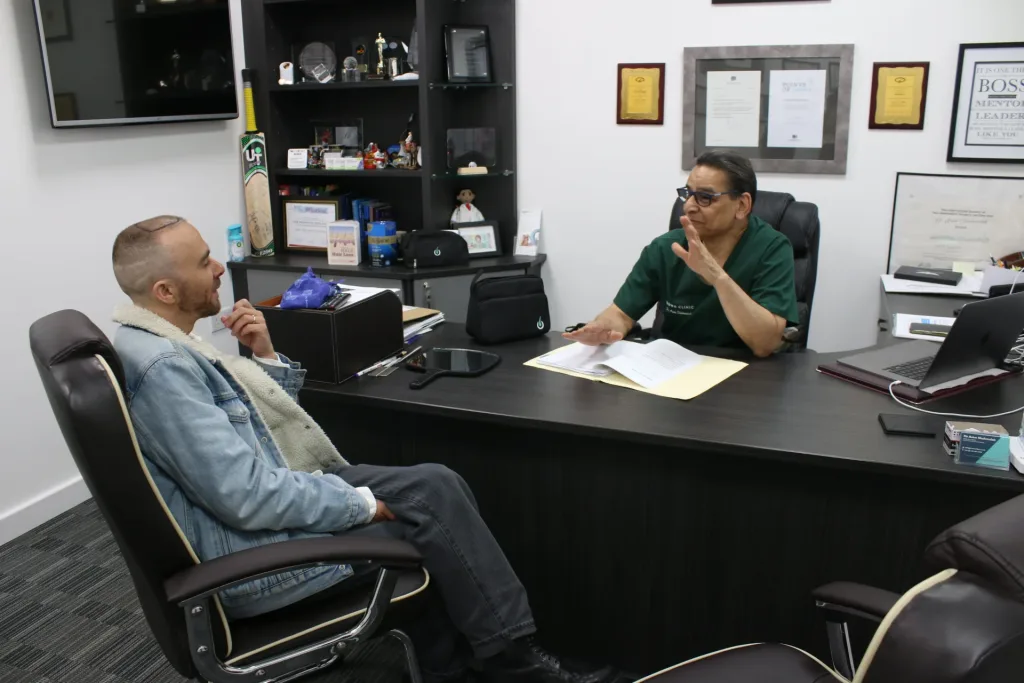
All of our patients will need a consultation before booking their surgery. This is so our team and Dr Shahmalak can advise you on the very best treatment for your individual and unique hair loss pattern.
During your consultation, we’ll be able to offer you insight into what realistic results you can expect and how many grafts will be needed in order to achieve the look you desire.
Your consultation is also where you can freely ask any questions you might have and raise any concerns or worries you might have about your procedure or your projected results.
Medications and supplements to pause before surgery
During your initial consultation, it’s important that you are open and honest about your current medications and supplements. This will help us to correctly advise which medications or supplements to pause or avoid before your procedure.
We highly recommend speaking to your GP to discuss any medications that may affect surgery. Some medications to highlight include blood thinners and anti-inflammatories like aspirin and ibuprofen.
Smoking, alcohol and lifestyle in the run-up
We want to ensure you get the very best results from your hair transplant, but smoking and drinking can both work against a smooth recovery.
Nicotine narrows the blood vessels that supply oxygen to your scalp, which can slow healing and affect how well your grafts take. We recommend stopping smoking for a couple of weeks before and after your transplant to make sure you give your new grafts the best chance possible.
Alcohol thins the blood and can leave you dehydrated, so it’s best avoided for a few days beforehand. Staying well hydrated and rested in the run-up helps set your body up for healing and can support strong graft survival.
What to arrange before the day (time off work, transport home)
We recommend all of our FUE hair transplant patients take at least 1 week to recover from their procedure. After 7 days, you are able to go back to work and resume your normal day-to-day routine.
As we only give a local anaesthetic, you are able to head home the same day of your procedure, and it’s perfectly safe to drive. However, after such a long day in the clinic, you might be more comfortable arranging transport home to allow you to properly rest and recover.
Due to our close proximity to Manchester Airport, we have plenty of transport options to and from the clinic. To see all of our recommended transport options, head to our Manchester clinic page.
What to bring and what to wear on the day
We aim to provide everything you might need on the day of your procedure, but there are some things we recommend bringing on the day to make your visit more comfortable.
Clothing (button-up shirts, so nothing goes over the head)
We recommend wearing or bringing a button-up shirt to wear once you have had your hair transplant. This is to avoid any clothing that needs to go over your head, as this can risk knocking the newly transplanted grafts.
For your procedure, you’ll be provided with a gown to wear while in the operating room. We recommend choosing comfortable bottoms to ensure you are as relaxed as possible, as it can be a long day.
Ideally, no cap should be worn within the first 12-24 hours to avoid disturbing any of the grafts. If you want to wear a hat after your hair transplant, then we suggest choosing a loose-fitting cap that has a mesh back to allow grafts to breathe. All of our patients are provided with a cap, should they want it, as part of their aftercare pack.
What to eat beforehand
As our procedures last the whole day, we suggest having a light but filling breakfast before coming in for your procedure. We will make sure to break for lunch, where your meal will be provided in your private recovery room. There are also complimentary snacks and drinks in your recovery room, should you need them.
Ideally, we say to avoid alcohol the night before, as alcohol thins the blood and is a diuretic. Avoiding it the night before offers you the best chance of having a comfortable and successful procedure.
We’d also suggest going easy on caffeine that morning, as it can be dehydrating. This includes coffee and any energy drinks.
The day of your FUE hair transplant at Crown Clinic, step by step
We’ll be in contact with you as we plan and schedule your FUE hair transplant, offering a full rundown of how your day will look. In the meantime, here is what you can expect from the day of your procedure.
Arrival and final consultation
You’ll arrive early in the morning and be greeted by one of our team, before heading into Dr Shahmalak’s office for your final consultation.
In this consultation, we will go over the procedure, the number of grafts planned and what you can expect from the day ahead. This will also be your chance to answer any final questions you might have about your transplant and dispel any concerns or worries about the procedure itself.
We will also ask to take some ‘before’ pictures of you, so we can review progress as your transplant heals. We may ask to use your before and after pictures as a case study for our website, which you are more than welcome to opt out of at any point. We will never use your images without your consent.
Preparing the donor area
Once your consultation is complete, we’ll take you through to the hair wash station, where we will start to prep the donor area. This will require shaving both the donor and transplant areas to ensure we can accurately place your grafts and get the most natural hairline possible.
After your head shave, you’ll be shown to your private patient recovery room, where you can get changed and enjoy the complimentary snacks while we get the operating room prepared for you.
Local anaesthetic — does it hurt?
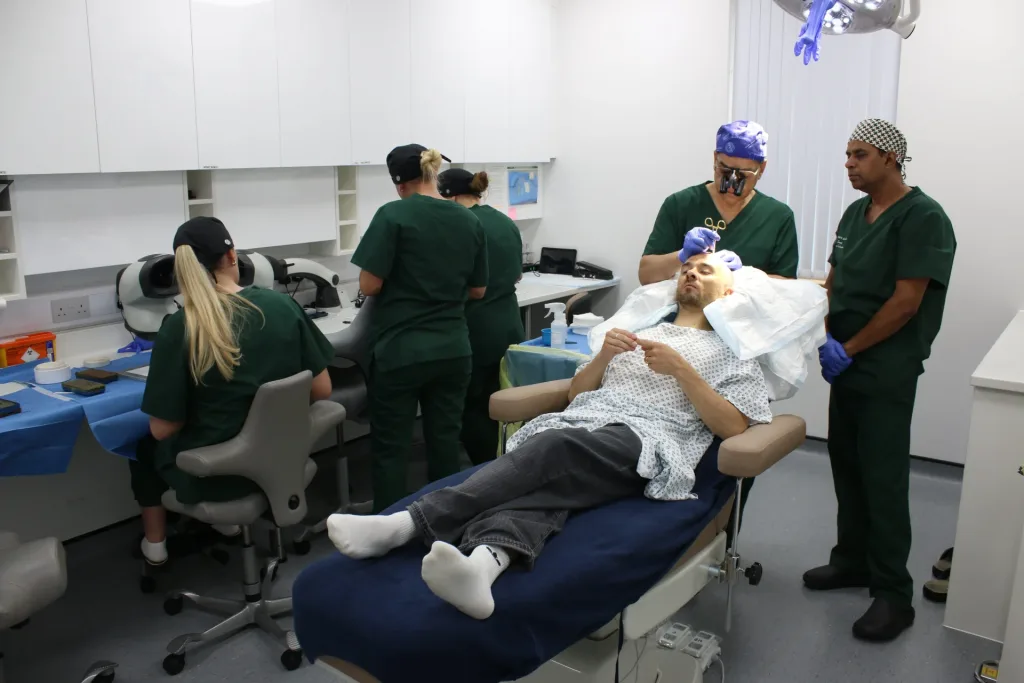
The first step of your FUE transplant is the local anaesthetic. Dr Shahmalak and his team will ensure the correct administration of anaesthetic to the donor and transplant areas. This is often the most painful part of the procedure; however, everyone’s pain thresholds are different.
Once the anaesthetic takes effect – usually within 2-10 minutes, depending on each individual – your procedure will be pain-free as the area will be numbed. Should you feel any discomfort during the extraction of your grafts, it’s important to inform Dr Shahmalak so that he can ensure you are as comfortable as possible.
Follicle extraction
Dr Shahmalak will then proceed to use a tool called a punch to extract the grafts from your numbed donor area. These grafts are then taken and analysed by our team of experienced hair transplant technicians to ensure the use of the highest quality grafts for your transplant.
This step is essential for ensuring we give you the most natural hairline possible. Our technicians carefully analyse your grafts under a microscope to prepare each graft for transplantation and sort the grafts according to the number of hairs each graft contains.
During your procedure, we’ll provide you with our Netflix account so you can watch whatever you’d like while the team works on your donor area and extraction.
Creating the recipient sites and implanting grafts
Before breaking for lunch, Dr Shahmalak will prepare the transplant area, creating small incisions for the grafts to be placed within. These incisions will follow the pre-approved hairline shape you’ve discussed with Dr Shahmalak in your consultations.
After lunch, our hair transplant technicians will start the placement of your grafts. Again, you’re welcome to watch TV while your grafts are placed. Using a blue dye to highlight the incisions, each graft is carefully placed to help create your ideal hairline and coverage.
Depending on the scale of the transplant area, this can take a few hours to complete.
How long does the procedure take?
From start to finish, the entire FUE procedure can take from 6 to 8 hours in total. The length of your procedure will, however, be based on the number of grafts needed in order to give you the coverage you’re looking for.
A more accurate timeframe will be provided to you during your initial and final consultations. You’ll be given a full rundown of how your day will look before you come in, to help you sort out any transport or accommodation needs.
Immediately after your procedure
After your FUE hair transplant has been completed, you’ll be shown to your patient recovery room to get dressed and decompress.
Aftercare instructions and your first 24 hours
Our team will then sit down with you to go through the full aftercare procedure and walk you through everything you get in our provided aftercare kit.
In the first 24 hours after your procedure, you’ll need to keep the donor and transplant area clean, using saline spray to help prevent infection. We recommend avoiding wearing a cap or wearing any clothing that needs to go over the head within the first 24 hours.
Do not shampoo your hair and ensure you sleep with your head elevated on 2-3 pillows over the next 3 days and take your medications as outlined in your post-op guide. It’s also important to avoid any exercise during the first 3 days, introducing gentle exercise from day 4 and building over the following week.
In your aftercare kit, we’ll provide you with:
- Saline spray, which should be sprayed on the grafts every 30 minutes for the first 3 days post-op.
- Shampoo, which is to be used gently from day 4 post-op and used for the following week.
- Prednisolone 5mg, a prescription anti-inflammatory to help with inflammation in the donor and transplant areas.
- Ciprofloxacin 250mg, a prescription medication to help avoid infection in the donor and transplant areas.
- A detailed post-op guide which will tell you how to shampoo, sleep, work, workout and what pain meds to take over the next 10 days to ensure maximum recovery.
- A branded Crown Clinic cap with a mesh back, to allow grafts to breathe while also covering your new transplant area.
- Branded Crown Clinic wash bag to keep all of your kit safely stored.
Getting home and resting
We strongly recommend taking a week off work in order to recover completely from your procedure. This allows you to carefully follow all aftercare instructions and allows you time to rest and recover fully.
Should you have any questions once you get home from your hair transplant, please feel free to contact us. We’ll be on hand to help with your recovery and highly recommend coming back into the clinic around 6-months post-op for a follow-up consultation, so we can check on your progress.
What to expect in the following days and weeks
Initial recovery from an FUE hair transplant takes around 10 days. By day 10, you will be able to go about your normal day-to-day routine. However, a full recovery and results take between 6 and 12 months in total.
Swelling, redness and scabbing
At first, you will notice some swelling, redness and scabbing around the donor area and transplant area. This is generally normal. If the area becomes especially inflamed or tender, however, we recommend contacting us directly to discuss.
You will notice over the next few weeks the crusting over of your grafts and scabbing on the donor area. Once normal shampooing resumes around day 9-10 post op, these scabs and crusts will be removed.
When you’ll see results (the shedding phase and growth timeline)
It’s important to note that you will notice some shedding as the grafts heal within the first 1-2 weeks. In weeks 2-4, you may notice more shedding of the transplant area. This shedding is completely normal. This shedding happens due to your body’s response to the surgical procedure; however, your roots remain, and only the hair shaft sheds.
Your transplanted grafts usually enter into a resting period within the first 3-6 months of recovery. Results from your FUE hair transplant take, on average, around 6 months to start to appear. Your full results should then be visible from around 12-months onwards.
Book your hair transplant consultation in Manchester
To get started on your FUE hair transplant journey, book your consultation with our team today.
Our consultations take place at both our Manchester and London clinics and offer you the chance to get a full picture of what you can expect, the number of grafts and a final bespoke quote for your transplant.
Frequently asked questions
An FUE hair transplant surgery takes between 6-8 hours, depending on the number of grafts needed. The recovery time for an FUE hair transplant takes between 6 and 12 months in order to see results.
Hair transplant surgery is a medical procedure, and some pain and discomfort are to be expected. The main discomfort, however, takes place during the administration of the initial local anaesthetic to the donor and transplant area. The rest of the procedure should then be pain-free. Some discomfort will be felt post-op as the area will be swollen and tender. We provide you with the right medications to help make this healing process as comfortable as possible, and regular over-the-counter paracetamol can be used to help with any initial post-op discomfort.
When done by a qualified and experienced surgeon, hair transplants are completely safe. We always suggest thoroughly vetting any hair transplant clinic you are considering and making sure your procedure is led first and foremost by a surgeon, not a salesperson.
Some key accreditations to look for are registrations with ISHRS and BAHRS, as well as being a registered UK surgeon with the GMC and having an excellent CQC rating – Crown Clinic has an outstanding rating from CQC.
Yes, you can wear a hat after your hair transplant. We recommend waiting at least 12-24 hours to allow initial healing of the transplant area. When choosing the right hat, make sure it is loose-fitting and ideally has a mesh back to allow the newly transplanted grafts to breathe.
To prepare fully for a hair transplant, make sure to have a thorough consultation with your hair transplant surgeon. Make sure you have asked any questions you might have about the procedure and the results you can expect to see.
Make sure to do your research around the right clinic for you and always aim to choose a qualified surgeon over a cosmetic technician. The hair transplant industry is predominantly unregulated, so ensuring you’re choosing a qualified surgeon is essential for both safety and quality of results.
Subject to the type of procedure, you may or may not need to shave your head fully. If needed, we will shave your head for an FUE hair transplant. This allows us clear visibility when extracting from the donor area and placing the new grafts. It’s this visibility that allows us to create the most natural results from your transplant.
Shaving your head also helps keep the donor and transplant area clean and prevents any increased chance of infection. It allows for the very best environment for optimal healing after your surgery.
You won’t need to shave your head before coming into our clinic, as we can do this for you as part of the pre-procedure process.